History of the Whiting 29
The Whiting 29 was designed by New Zealand yacht designer Paul Whiting. Initial drawings for a “stretched Reactor” design were published in Sea Spray magazine in September 1977. Conceived primarily for owners of Whiting’s successful Reactor 25 who wanted a larger yacht without giving up the performance characteristics for which his designs were becoming well known.
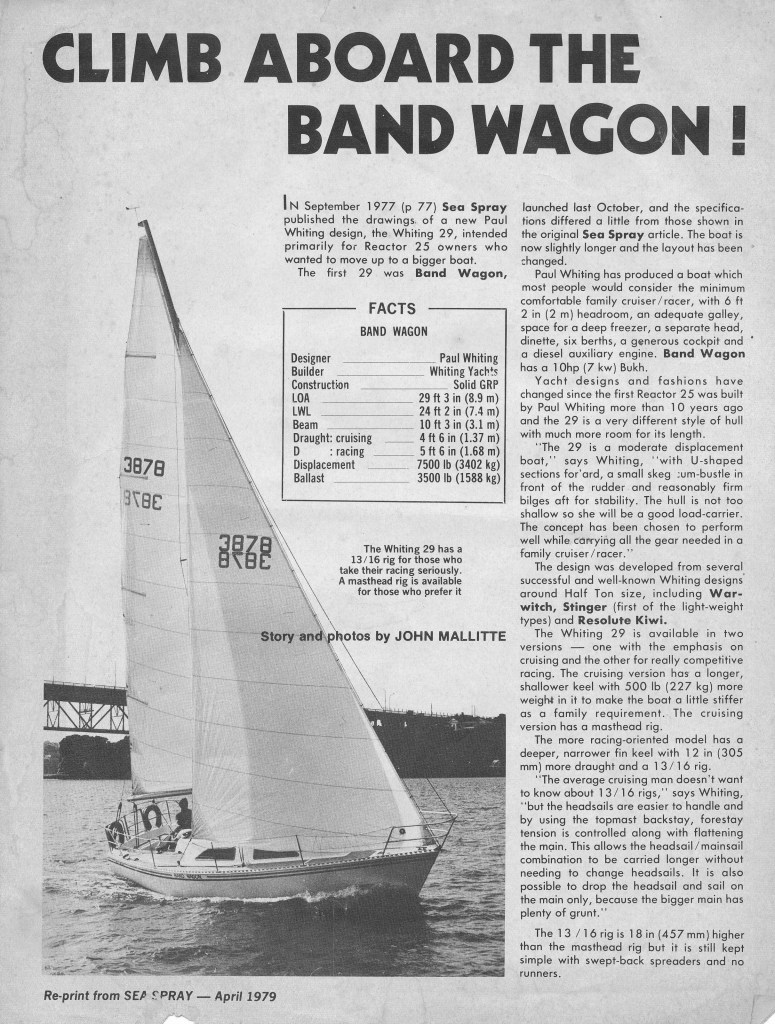
The first Whiting 29, Band Wagon, was launched in October 1978. By April 1979, when Sea Spray published its contemporary article “Climb Aboard the Band Wagon!”, a number of Whiting 29s were already under construction or being completed.
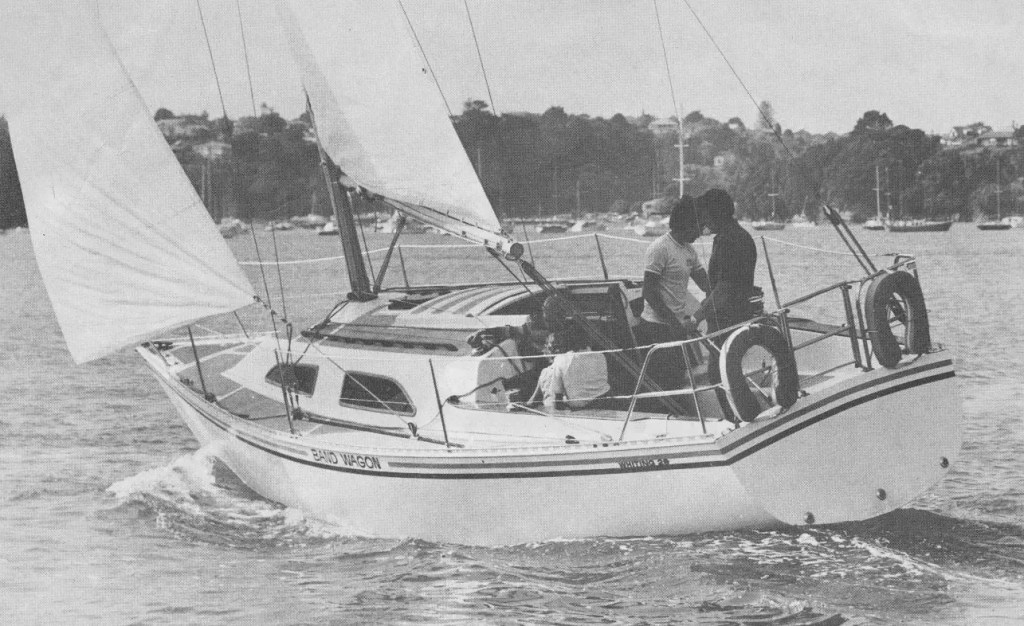
The article provides a fascinating contemporary description of the new 29-footer, including its design, construction, accommodation, rig options and the thinking behind the cruising and racing versions..
The new yacht represented a significant step up from the Reactor 25. Although only about four feet longer, the Whiting 29 had considerably more volume and accommodation, making it a genuine family cruiser/racer rather than simply a larger racing boat.
The first Whiting 29 was also displayed at the National Boat Show in September 1978, helping to introduce the new design to the New Zealand sailing public.
A new generation of Paul Whiting design
The Whiting 29 reflected the evolution of Paul Whiting’s thinking during the 1970s.
The design drew on several of his successful Half Ton-sized yachts, including Warwitch, Stinger and Resolute Kiwi. Stinger was particularly significant as one of Whiting’s early lightweight designs.
Compared with the Reactor 25, the Whiting 29 had a substantially more spacious hull. Paul Whiting described it as a moderate-displacement boat, with U-shaped forward sections, a small skeg or bustle ahead of the rudder and reasonably firm aft bilges to provide stability.
The hull was deliberately designed to carry the equipment and stores required for family cruising while still providing good sailing performance.
This combination of performance and accommodation became one of the defining characteristics of the Whiting 29.
Two versions of the Whiting 29
From the beginning, the design was offered in two basic configurations: a cruising version and a more racing-oriented version.
The cruising version had a longer, shallower keel containing approximately 500 lb (227 kg) more ballast. This additional weight made the boat somewhat stiffer and was intended to improve its suitability as a family cruiser.
The cruising model was fitted with a masthead rig.
The racing version had a deeper, narrower fin keel, with approximately 12 inches (305 mm) more draft, and was fitted with a 13/16 fractional rig.
The 13/16 rig was approximately 18 inches (457 mm) higher than the masthead rig. Despite its greater height, the rig was deliberately kept relatively simple, using swept-back spreaders and no running backstays.
Paul Whiting believed that the fractional rig offered significant advantages for sailors interested in performance. The headsails were relatively easy to handle, while the adjustable backstay allowed forestay tension and mainsail shape to be controlled effectively.
Designed as a cruiser-racer
Paul Whiting’s aim was not simply to produce a fast racing yacht. The Whiting 29 was designed to remain useful when loaded with the equipment required for family cruising.
The early boat provided approximately 6 ft 2 in (2 m) of headroom, an adequate galley, separate heads, a dinette, six berths and a generous cockpit.
The first Band Wagon was fitted with a 10 hp (7 kW) Bukh diesel auxiliary engine.
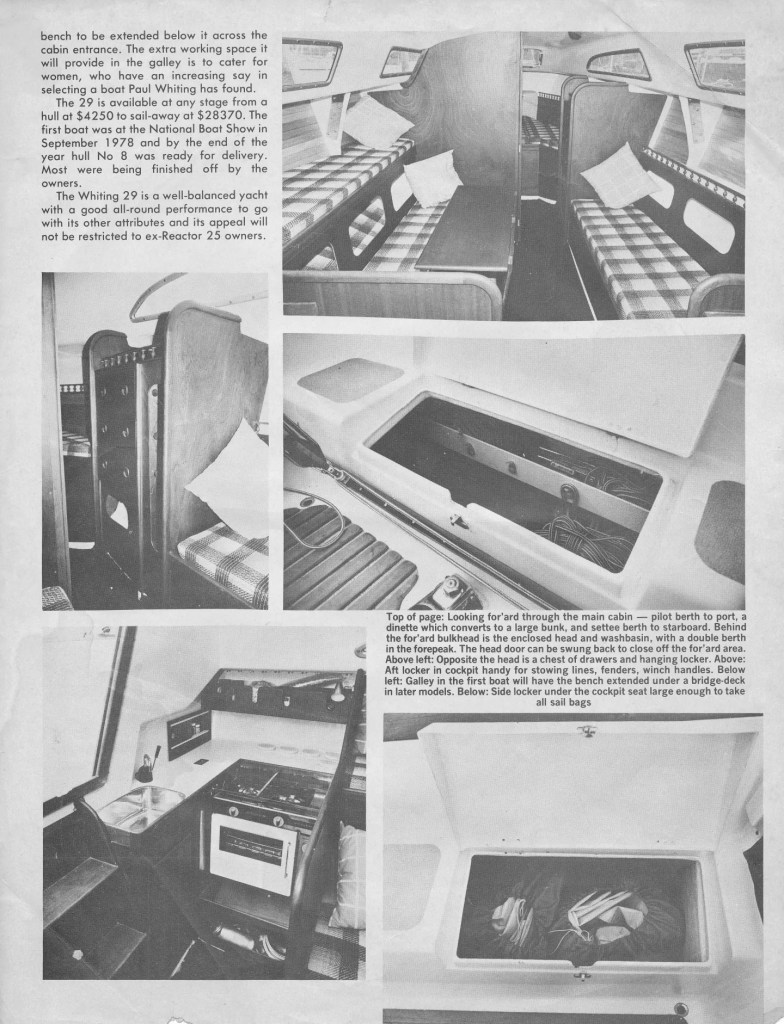
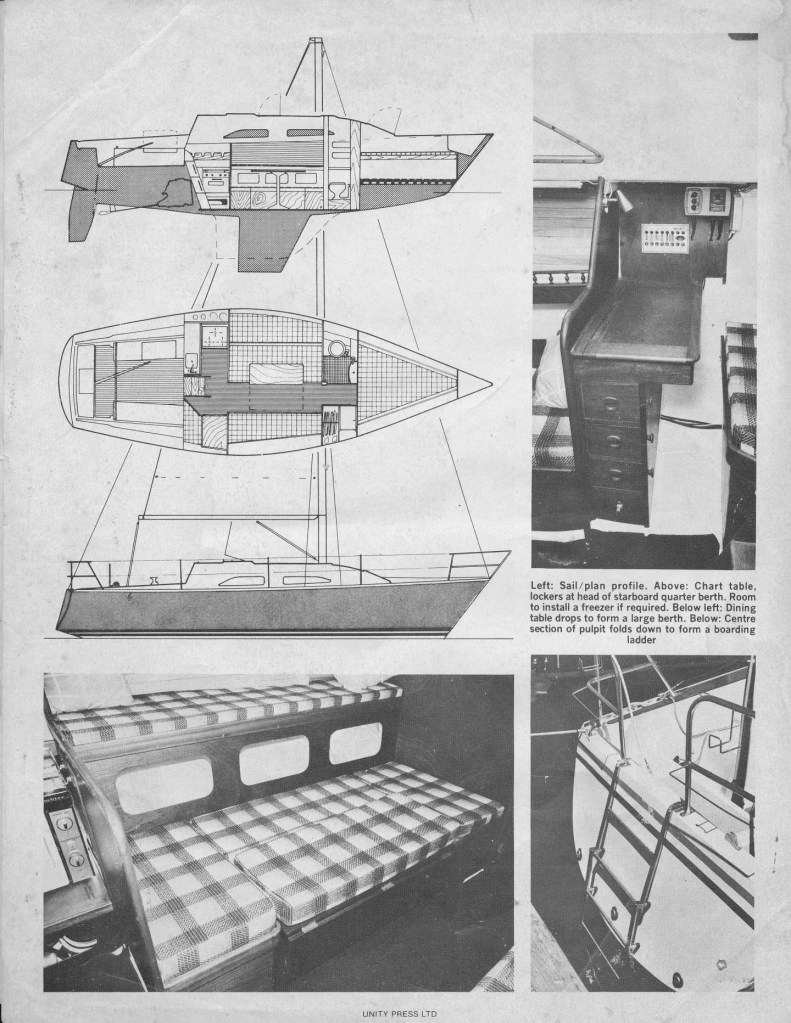
The accommodation was unusually spacious for a 29-foot yacht. The layout included a forward double berth, enclosed heads and washbasin, a main cabin with settee and pilot berths, a dinette that could convert into a large berth, and a galley.
There was also provision for substantial storage, including lockers capable of accommodating sails and cruising equipment.
The designers clearly recognised that a successful cruiser-racer had to be practical as well as fast.
A spacious cockpit
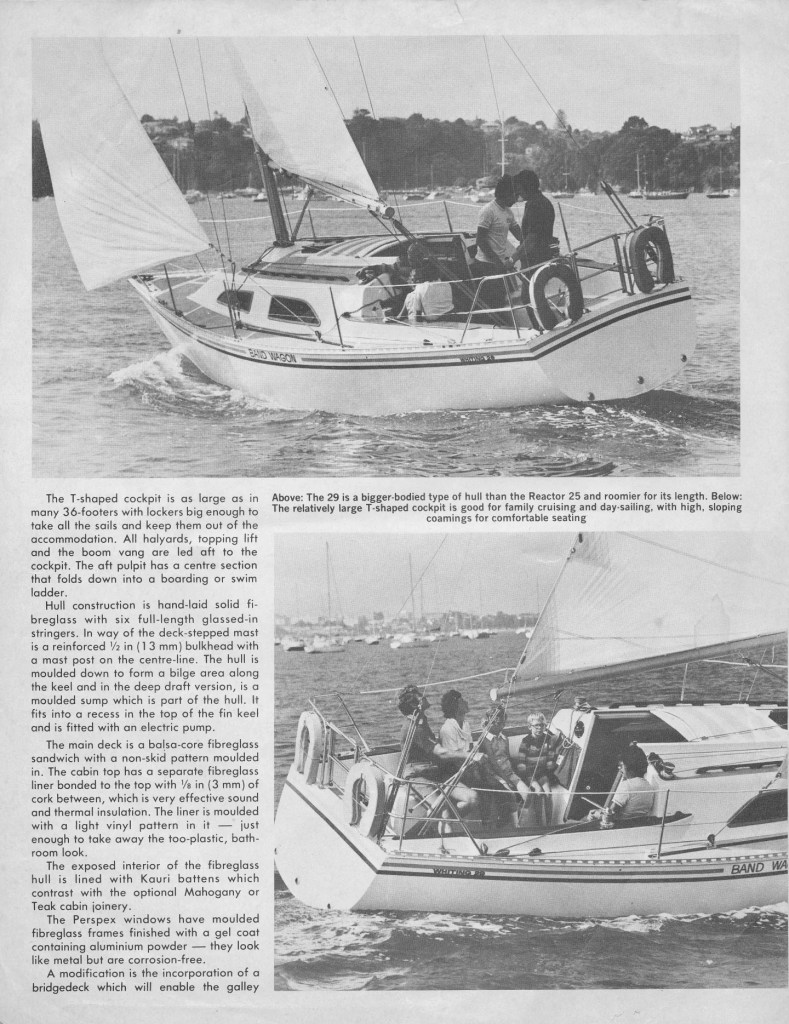
One of the most distinctive features of the Whiting 29 was its large T-shaped cockpit.
The contemporary Sea Spray article noted that the cockpit was comparable in size with those found on considerably larger yachts. Large cockpit lockers provided storage for sails and other equipment without taking space away from the accommodation.
The halyards, topping lift and boom vang were led aft to the cockpit, making sail handling easier for a small crew.
The centre section of the aft pulpit could also be folded down to provide a boarding or swimming ladder—an early example of the practical details incorporated into the design.
Construction
The Whiting 29 was constructed in solid hand-laid fibreglass, with six full-length glassed-in stringers providing longitudinal reinforcement.
The mast was deck-stepped, with additional reinforcement around the mast support.
The main deck used a balsa-core fibreglass sandwich construction, with a moulded non-skid surface.
The cabin top incorporated a separate fibreglass liner with a cork layer providing sound and thermal insulation. The interior of the fibreglass hull was lined with Kauri battens, while optional Mahogany or Teak joinery could be specified for the cabin.
The windows were made from Perspex and fitted into moulded fibreglass frames.
These construction methods produced a relatively light but strong yacht, consistent with Paul Whiting’s emphasis on performance.
Accommodation for a 29-foot yacht
The early Whiting 29 demonstrated how much accommodation could be incorporated into a relatively compact performance yacht.
The main cabin included:
- A forward double berth
- Pilot berth
- Two settee berths
- A convertible dinette
- Enclosed heads
- Washbasin
- Galley
- Extensive storage
- Cockpit lockers
- Provision for a freezer
The article also describes a bridgedeck modification that allowed the galley bench to be extended beneath the cockpit entrance, providing additional working space.
The result was a yacht that was intended to be comfortable enough for family cruising without sacrificing its sailing performance.
Band Wagon — the first Whiting 29
Band Wagon was the first production Whiting 29 built.
The boat was launched in October 1978 and was subsequently featured in Sea Spray in an article entitled “Climb Aboard the Band Wagon!”
The contemporary article described Band Wagon as a new generation of Whiting design: a larger-bodied yacht than the Reactor 25, with considerably more room for its length.
The published specifications for Band Wagon were:
| Specification | Band Wagon |
|---|---|
| Designer | Paul Whiting |
| Builder | Whiting Yachts |
| Construction | Solid GRP |
| Length overall | 29 ft 3 in (8.9 m) |
| LWL | 24 ft 2 in (7.4 m) |
| Beam | 10 ft 3 in (3.1 m) |
| Draft – cruising | 4 ft 6 in (1.37 m) |
| Draft – racing | 5 ft 6 in (1.68 m) |
| Displacement | 7,500 lb (3,402 kg) |
| Ballast | 3,500 lb (1,588 kg) |
The article noted that the specifications had already changed slightly from the original drawings by the time Band Wagon was launched, with the production boat being slightly longer and having a modified interior layout.
This is an important point when comparing specifications from different sources: the Whiting 29 was developed during the early production period, and individual boats and versions were not necessarily identical.
The Whiting 29 enters production
The Whiting 29 was offered in a range of stages from a bare hull through to a complete sail-away yacht. The contemporary article gives prices ranging from $4,250 for a hull to $28,370 for a sail-away boat, reflecting the different levels of completion available to owners.
Many of the early yachts were finished by their owners.
This approach was common in New Zealand at the time and helped make performance yachts accessible to sailors who were prepared to undertake some of the fitting-out themselves.
By the end of 1978, the first eight hulls had already reached the delivery stage, demonstrating the early popularity of the design.
A successful cruiser-racer
The contemporary Sea Spray review concluded that the Whiting 29 was a well-balanced yacht offering good all-round performance.
That description has proved remarkably enduring.
The design was sufficiently competitive to appeal to racing sailors while offering enough accommodation, storage and comfort for family cruising. This balance helped the Whiting 29 establish itself as one of Paul Whiting’s notable production designs.
More than four decades later, surviving Whiting 29s continue to be raced and cruised around New Zealand.
Many have been modified over the years, with changes to rigging, engines, interiors, sails and navigation equipment. Yet the fundamental characteristics of the original design remain evident.
The Whiting 29 today
The history of the Whiting 29 is now preserved not only in contemporary sailing publications but also in the boats themselves.
Many of the yachts built during the late 1970s and 1980s are still sailing today. Some remain close to their original configuration, while others have evolved considerably under successive owners.
The Whiting 29 Boat Register on this website aims to document as many of these yachts as possible, recording their hull numbers, names, sail numbers, locations, owners, histories and photographs.
Each surviving boat represents a small part of the history of Paul Whiting’s design.
View the Whiting 29 Boat Register →
Source
Much of the early history described above is based on an article published in Sea Spray magazine:
“Climb Aboard the Band Wagon!”
Story and photographs by John Mallitte
Sea Spray, April 1979
Reprinted from the original article.
The article provides an invaluable contemporary record of the first Whiting 29, its design philosophy, construction, accommodation and the thinking behind the different cruising and racing versions.